
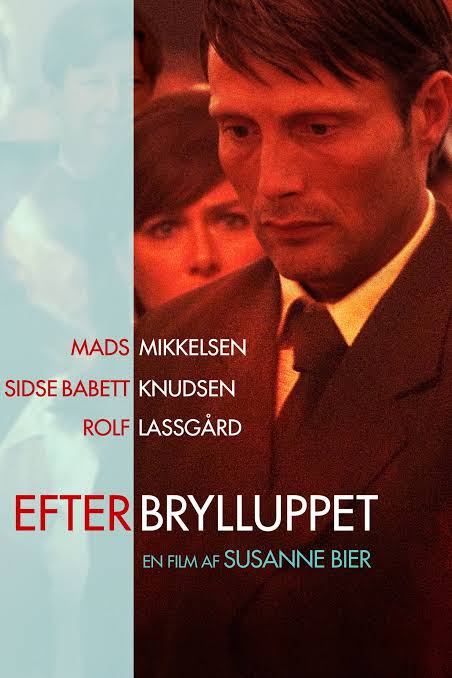
After the Wedding
To this day, I still have not watched the American remake of After the Wedding. I have only seen the trailer, and honestly, it already felt like a very different movie to me. So everything here is about Susanne Bier’s original Danish version.
This is also another Susanne Bier movie, after In a Better World, and I feel like I can see some similarities between them. Once again, part of the story takes place far away from Denmark, this time in India, and once again she takes a fairly unusual situation and turns it into something very emotional and morally complicated.
Jacob, played by Mads Mikkelsen (yes, again), works at an orphanage in India that desperately needs money. A wealthy Danish businessman named Jørgen offers a huge donation, but insists that Jacob come to Copenhagen himself. Once there, Jacob is unexpectedly invited to the wedding of Jørgen’s daughter.
And naturally, this is where things stop being simple.
Spoilers from here 🙂
At the wedding, Jacob realizes that Jørgen’s wife, Helene, is someone from his own past. Then comes the much bigger revelation: Jørgen’s daughter Anna is actually Jacob’s biological daughter.
Eventually, another piece falls into place. Jørgen is dying, and suddenly his strange interest in Jacob makes much more sense. He is not simply trying to donate money to an orphanage. He is trying to bring Jacob back into this family before he himself is gone. He wants Anna to have her biological father nearby, and he also knows that Helene and their young sons will soon have to continue without him.
When I reduce the story to one sentence, it sounds almost absurd:
A dying man brings another man into his family so that this man can be there for his wife and children after he dies.
Written like that, it almost sounds like another one of those completely unorthodox Danish movie plots where the first reaction might simply be: What are these people doing?
But the more the story unfolds, the less strange Jørgen’s plan feels.
That is probably what I found most interesting about the movie. He knows that he is running out of time, and instead of only thinking about his own fear of dying, he is trying to arrange something for the people who will still be there afterwards.
There is also something uncomfortable about it, of course. He is manipulating Jacob to some extent. He knows things Jacob does not know, and he places him in a situation where simply returning to India becomes much more complicated.
But I do not think that makes Jørgen’s intentions feel cruel.
Quite the opposite, actually.
There is something very sad about watching a man who knows he cannot stay and therefore starts quietly trying to prepare everyone else for his absence.
One of his lines probably expresses that part of the movie best:
“Time is precious… Every acquaintance, every friend, every person who has a place in your heart… it is the time with them that really means something.”
Like quite a few Danish movies I have watched, After the Wedding takes something that could almost sound like an exaggerated soap-opera plot and somehow makes it feel very human.
Open Hearts did something similar for me. The situations are unusual, sometimes even uncomfortable, but the people inside them never feel like they are there only to create drama.
There is always this interest in what people do when relationships, family, responsibility and morality become much messier than they were supposed to be.
And I think that is why After the Wedding was definitely worth watching for me.
It was strange, emotional and sometimes uncomfortable.
Basically, a fairly normal evening with Danish cinema. 🙂